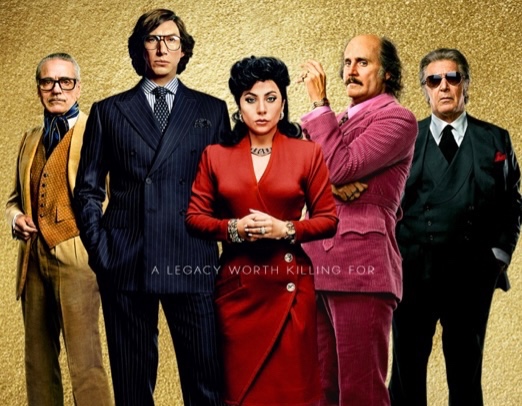
For most of us, the world of high fashion or haute couture if you’re fancy, is a spectator sport. From the pages of Vogue to the frolics of films like the Devil Wears Prada, beyond the occasional indulgence, its mostly a life we look at from afar. But for multi generational families like the Guccis, where fashion is both a livelihood and a legacy, it’s in your face personal.
That brings us to Ridley Scott’s latest offering, House of Gucci, which recently opened on a streaming platform near you. If you’re familiar with any of the ‘feedback’ that current members of the Gucci family have bestowed upon Mr. Scott, you know they are not very happy. That’s mainly because the film depicts a world filled with deception, greed, lust and betrayal. Not a particularly flattering representation of a family who’s name adorns some of the most exclusive items in ladies and mens fashion. And maybe they have a point because while the real life killing of Maurizio Gucci (at the behest of his former wife Patrizia Reggiani) is true, at least some of the Gucci family’s dramatically bad on screen behavior, is most likely over embellished for the sake of entertainment. Sadly, to that end, it’s this over embellishment and the choices of some of the actors and the filmmaker himself that proves to be the chink in this film’s armor.
We can start with Al Pacino who no one would dispute is one of the best actors of his generation. But there’s documented evidence that Pacino can swing and miss and his characterization of Aldo Gucci is an example. He may be the right age to play the Gucci family patriarch but a quick Google search proves that his wild hair, corpulence and over the top behavior are not consistent with the recollections of the people who knew Aldo Gucci. And even if it was, his larger than life performance just doesn’t work. It’s a shtick he’s tried before with success but this time it wears like an ill-fitted suit.
And then there’s Jared Leto as Aldo’s disappointing son Paolo. Is this the same guy from Fight Club, Requiem For A Dream and Dallas Buyers Club? With more wild hair (this time topped with a bald skull cap) and a wardrobe that appears to have been selected from the leftovers at a third hand thrift shop, there’s nothing fashionable about Leto. In fact, after awhile I started to feel sorry for him, in much the same way you feel sorry for the clown who just found out that Ringling Bros left town years ago without him. I know, I’m in the minority here because Leto’s performance is being heralded as something akin to Brando in On the Waterfront – but I just don’t get it.
But what about Gaga you say as the scorned Patrizia Reggiani. Clearly the Lady is perfectly cast, right? She certainly looks the part, the eyes, the hair, the swagger… Bellissimo! Perfecto! Well here’s the thing, it’s not a particularly memorable performance. I know, again, I’m pretty much alone on this. The fact of the matter is Lady Gaga is a remarkable vocalist. She glides through musical genres with the ease of an olympic figure skater and she will be remembered as one of the greatest singers of her time. But in my opinion, unlike some who previously made the move to the screen, the likes of which include Sinatra, Streisand, Cher and Kristofferson, she’s not particularly transcendent. I’ve always thought her acting was, I don’t know, how would you say it…meh. It’s simply not a stretch to play this role and not withstanding the striking resemblance, its my personal opinion that Ms. Germanotta should sing more and act less.
So you ask… did you like any of the performances? In fact I did, Adam Driver as Maurizio and Jeremy Irons as his father Rodolfo are pitch perfect. Irons portrays the tortured brother of Pacino’s Aldo. As a Gucci heir, he owns an equal share of the world renowned brand but chose a different path as an actor. His character’s failure to achieve success is written all over his face and along with his wardrobe, Irons delivers an impeccable performance. The same can be said of Adam Driver who, regardless of whether he’s playing a 17th century Jesuit or a bored bus driver, rarely disappoints. Driver’s Maurizio is a nuanced character study of a son who never wanted to be part of the family business but ends up at the top of the house. His metamorphosis into the cold and calculating executive who has little regard for anything else is ironically reminiscent of the performance that Pacino once delivered as Michael in The Godfather.
While the other elements of the film are fine (its hard to mess up the cinematography when you’re afforded the vistas of Tuscany, Piedmont and the Swiss Alps) I kept thinking that something was missing from House of Gucci. I mean come on, over the course of two hour thirty eight minutes of run time no one speaks a word of credible Italian. What self respecting Italians, living in Italy, would sing Happy Birthday in English? We even have to wait until the third act when the actor portraying fashion icon Tom Ford appears; to actually demonstrate that this is the business of high fashion.
And that, my friends, is the rub that ruins this film. What House of Gucci lacks is a level of authenticity that could have elevated it beyond its reductive soap opera feel. A more authentic film could have showcased the world which elevated the Gucci name to the apex of fashion. But in their zeal to tell a caper story of greed and lust, the creators of House of Gucci missed that one important task. They failed to illustrate the culture and the people that make this world of high fashion so captivating, so intoxicating that they would risk everything to remain a part of it. In fact, if the current day Gucci family stepped back from their personal grievances with Ridley Scott perhaps they would see that too.
 Writing Act Three