 Any viewer of Edgar Wright’s Baby Driver will immediately be struck by its energy, creativeness and soundtrack – it never lets up. If you can – think La La Land meets Pulp Fiction. Highly stylized from both a visual and musical standpoint the film is captivating. The creative use of music breaks new ground for a film with this much action and like me, you may be convinced this is a thrill ride for the ages. But Baby Driver ultimately runs wild and as it speeds into its third act it becomes a victim of its own excesses. It’s kinda like a velociraptor in Jurassic Park – beautiful and a marvel to watch until it escapes from its cage and starts to devour everything in sight. Jurassic Park though is science fiction, heist movies are supposed to be grounded in a semblance of reality. So when Baby Driver goes off the chain you might just be left wondering… where is Edgar Wright going and why?
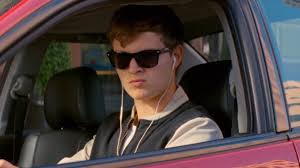
Ansel Elgort is adequately cast as the young but talented wheel man who goes by the name of Baby, a pseudonym for his real name which is Miles, another pseudonym (albeit a lame one) because, you know…he drives cars – ok, I digress. But with limited and not particularly memorable dialogue Elgort seems to be more of a visual prop for the film than its central character. And while this role may not serve as a resume builder for the actor’s bid for the next Henry VIII – it does work in the overall style and theme of the film. Constantly adorned in Ray Bans and ear buds, the cool as a cucumber Elgort’s every step and lip synch is expertly choreographed as the music blares through his head and onto the screen. In effect he becomes the vehicle for this marvelously diverse and creative soundtrack that makes the film so watchable. And for all intents and purposes it’s the music that becomes the main character, keeping time with the action and transforming the movie into something more than just another heist story. Adding to the excitement, young Ansel’s character can drive the heck out of just about anything with a steering wheel. The high speed careening through the streets of Atlanta is not only entertaining but technically believable and pays a remarkable homage to the likes of Bullet, Ronin and the French Connection.
Getting back to the script, all is not lost in that department for actors Jamie Foxx, Jon Hamm and Kevin Spacey who play the really bad guys. Their characters are rich in clever dialogue and their performances are rewarding across the board as each actor executes up to his veteran status. Foxx and Hamm are particularly good as the unpredictable and at times psychotic heist men who will stop at nothing once the clock starts ticking. Spacey on the other hand plays Doc, the thoughtful but equally merciless mastermind planner who sees all the angles ahead of time while leaving the stick’em up part to everyone else. He pulls all the right strings in his performance but unlike Foxx and Hamm, it’s a cadence and rhythm we’ve seen before in his other bad guy roles. There are supporting roles for Lily James and Eiza Gonzalez as love interests for Elgort and Hamm respectively but sadly neither character is developed enough to give either woman a chance to demonstrate her skill. And in a twist you can see coming from a mile away Kevin Spacey’s bad guy turns out to be not so bad after all.
It’s at this point in the film (when Spacey turns out to be the bad guy with a heart) that everything starts to go off the tracks. The level of violence increases by an order of magnitude that almost makes it unwatchable and unbelievable. An otherwise incredibly suspenseful diner scene is needlessly marred by violence and gunfire that doesn’t support the narrative. To make matters worse, there’s a stretch where Jon Hamm is transformed into an unbecoming version of the Eveready Bunny who just won’t die. It’s a waste of all the hard work he puts into the character and leaves him to deal with a less than flattering Terminator style demise. Director Edgar Wright makes no secret of the fact that he draws much inspiration from Quentin Tarantino and for the most part during the heart of the story it pays off. Yet one is left to wonder whether at one point or another Tarantino himself would have yelled – Cut.
It’s no surprise that Baby, who had a rough childhood, is a victim in all of this and in an effort to bring the story back to center, Wright attempts to put a bow on the film with a brief but well stylized denouement. It’s an admirable effort and left me feeling somewhat better. But I was still a bit unsatisfied because when all is said and done Baby Driver is a good film that could have been great if its director had exercised a little restraint. Perhaps Mr. Wright should have taken a cautionary lesson from Jurassic Park – cleaning up a mess is hard, sometimes it’s just easier to keep an eye on the cage.
 Writing Act Three