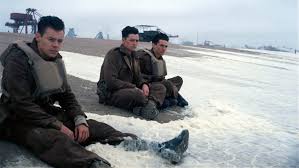
 Early on in Dunkirk, a boy in his late teens asks; “Mr Dawson, where are we going?” The straightforward reply“Into war, George” puts everyone on notice that we are about to enter into a highly visceral and intimate cinematic experience. And let’s get this out now – director Christopher Nolan’s depiction of this historic effort to rescue nearly 400,000 British, French, Belgium and Canadian troops in the face of an advancing German Army in the early days of World War II is the work of pure genius. It may not be the greatest war movie ever made but it is perhaps the most unique and inventive account of war ever presented in our time.
Fans of Nolan know that he likes testing the limits of the cinematic narrative. Films like Memento, Inception and even elements of his Batman Man Dark Knight Trilogy require an investment on the movie-goer’s part as this director, whose work at times is referred to as scientific, takes you on a journey through his mind’s eye. Dunkirk is no exception.
Told in three parallel panels – the Air, the Mole (Land) and the Sea – Mr. Nolan employs a non linear narrative to tell the story of the greatest wartime rescue ever. For those of us who didn’t go to film school that means the story unfolds from different points of view in a non-traditional timeline. You’ll see the same scene from different perspectives, each important to the overall narrative but only how and when the point of view character sees them. So munch that popcorn slowly because you won’t be getting up for any refills. But here’s the good news, Nolan presents this story in 106 minutes and what he captures in that relatively brief window is nothing short of remarkable.
The POV duties for each principal aspect of the film are placed in the hands of three very capable actors; Tom Hardy, Mark Rylance and Fionn Whitehead. And while this is a big movie, Nolan makes a bold choice – he effectively places each man in a relatively confined space. It creates a tautness to the film that works incredibly well and pays off throughout the story.
For Hardy, who could read a shopping list from Amazon and be entertaining, it’s from the cockpit of a Supermarine Spitfire. Shrouded in flight helmet, scarf and oxygen mask for much of the film, his depiction of the RAF pilot Farrier seems incredibly real. It’s a risk for an A list actor to take on a role with such a narrow visual but Hardy hits a homerun. His ability to communicate using his eyes, facial muscles and the tonality of his radio calls is pure movie star.
Fionn Whitehead a Hollywood newcomer is Tommy who we first find running for his life through the narrow streets of Dunkirk. It’s through Tommy’s eyes that we get our initial glimpse of the shore and as his field of vision broadens we see the vastness of the beachfront. Through Tommy we begin to appreciate the countless numbers of men lined up for what appears to be a hopeless rescue. Later in the film he seeks refuge in the hull of a beached fishing trawler. Along with others he waits for the tide to carry the vessel to sea and as they wait each moment is more suspenseful than the last.
For the Sea, Nolan counts on the world class Rylance. His Mr. Dawson pilots the Moonstone representing the 700 or so private vessels and British citizens that left Ramsgate, England for the beaches of Dunkirk to save their fellow countrymen. Along with his son Peter and Peter’s friend George, they make the dangerous trip across the English Channel. Utilizing Mr. Rylance’s character alone to represent the vastness of the citizen rescue effort was a risk. But as the saying goes, risk equals reward and Mark Rylance rewards the viewer with a fine performance, filmed almost entirely from the pilot wheel of the motor yacht. As with the other two perspectives, it’s less about the dialogue and more about the situation and the expressive nature of the actors that makes this work as one by one they save the lives of stranded soldiers and airmen.
How do we keep track of these three as they fly, sail and run around Dunkirk? Who brings this all together for us? Well that would be Kenneth Branagh as Commander Bolton who one might say has a minor role. But there’s nothing minor about Branagh’s purpose in the film. Start to finish we find him on the dock of ‘the Mole’ which is the only deep water spot that can handle a vessel with a draft greater than three feet. It’s Branagh who, as he directs the wounded and the weary, explains that and so much more to us. And while Hardy, Rylance and Whitehead are doing a spectacular job on the inside looking out, its Mr. Branagh’s Commander Bolton who takes all the action in as the ‘viewer’- he witnesses Dunkirk. No small feat for an actor who gets limited screen time and few lines but the accomplished Branagh is superb and does an admirable job of being the glue that holds this story together.
Far from a character study, Dunkirk focuses all of its energy on a particular point in time. We learn little about these individual soldiers and sailors beyond their mission and from my ‘point of view’ that’s just fine. Because the Miracle of Dunkirk represents more than any one character could possibly portray and in that respect the British-American Nolan has captured it perfectly. For in creating this film he not only pays homage to his craft but also to a far greater and enduring constituency – those who vowed to never surrender.
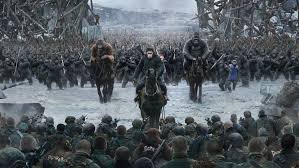 In the late spring of 1968 on a warm Saturday afternoon, I walked up Staten Island’s Tysens Lane to the corner of Hylan Boulevard with a friend from elementary school. Crossing Hylan we headed to the shopping center that was anchored by the Fox Plaza Theatre. In black plastic letters the theater’s marque announced the current feature; Planet of The Apes- Charlton Heston and Roddy McDowall.
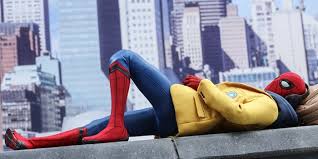 Spider-Man Homecoming represents the third time in 15 years that this comic book hero has been re-booted for the movies. Directors Sam Raimi and Marc Webb got plenty of mileage out of the academically brilliant but awkward teenager turned superhero with Tobey Maguire and Andrew Garfield respectively. Now the 36 year old Jon Watts, with a resume that lists Cop Car and Clown as his noteworthy efforts, takes aim at this successful franchise. He brings a fresh take to the story that’s filled with action and excitement. Is the third time the charm? Is a tub of buttered popcorn hard to resist?
 Any viewer of Edgar Wright’s Baby Driver will immediately be struck by its energy, creativeness and soundtrack – it never lets up. If you can – think La La Land meets Pulp Fiction. Highly stylized from both a visual and musical standpoint the film is captivating. The creative use of music breaks new ground for a film with this much action and like me, you may be convinced this is a thrill ride for the ages. But Baby Driver ultimately runs wild and as it speeds into its third act it becomes a victim of its own excesses. It’s kinda like a velociraptor in Jurassic Park – beautiful and a marvel to watch until it escapes from its cage and starts to devour everything in sight. Jurassic Park though is science fiction, heist movies are supposed to be grounded in a semblance of reality. So when Baby Driver goes off the chain you might just be left wondering… where is Edgar Wright going and why?
 Writing Act Three