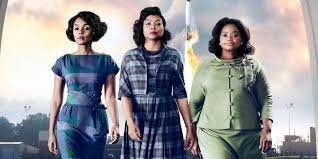
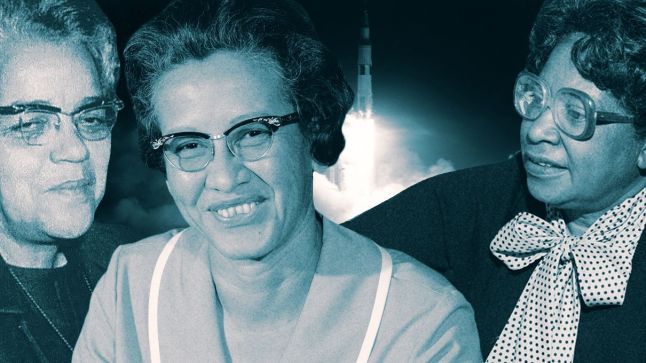
On February 20, 1962 NASA launched the first American into orbit around the earth. Powered by a Mercury-Atlas rocket every school child and adult alike knows that John Glenn was in that Mercury capsule. But most of us have little knowledge of those who made that achievement possible – especially the contributions of 3 African-American women; Katherine Johnson, Dorothy Vaughan and Mary Jackson. Thanks to Hidden Figures, a well crafted feel good movie about the pride and prejudice of one of the most significant periods in our history, their story is finally told.
Implied by its title, the film is a dual narrative which tells the story of the role these exceptionally talented women played during the Mercury space program as well as the indifferent and at times cruel treatment they suffered in a 1960s segregated Virginia. Kevin Costner as the fictional Al Harrison is perhaps the most recognizable cast member with the longest list of acting credits to his name. Cleverly inserted among the story’s real life historical figures, Coster is the glue that holds the narrative together. He’s well cast as a wry and seasoned pragmatist who embodies the voice of reason. He provides an added dimension of reason for the extraordinary efforts at NASA during the space race and eventually becomes the champion for the women of color at Virginia’s Langley Research Complex.
But its Tarija P. Henson, Octavia Spencer and Janelle Monae as Johnson, Vaughan and Jackson respectively that are the heart of this film. Accomplished, each in their own right, these actors are well cast. They concurrently embody not only the spirit of what was so right with America in 1962 but also, as they bear the unjust burden of color, what was so wrong.
Henson is particularly effective as the brilliant Katherine Johnson. Looking beyond the numbers, as only a true mathematician can, she tackles Glenn’s Friendship 7 re-entry calculations which others see as unsolvable because of the limitations of existing mathematical formulas. Reflecting the spirit of the American “can do” age she’s also the unfortunate recipient of its cruel inequalities. In a well executed scene where Costner’s Harrison questions her long mid day absences she stoically explains that she must walk a half mile across the campus to find the nearest colored bathroom. The fact that Harrison was oblivious to this in the first place is a sad reflection of a society conditioned to accept institutionalized segregation and the pain and shame it imposed.
With award-winning roles in films such as The Help and Fruitvale Station, its a joy to watch Octavia Spencer as Dorothy Vaughan. She is the epitome of someone who will not be victimized by her situation – a role model for anyone who feels that someone or something is holding them back. With dignity and perseverance she charts a path to break free. Spencer is an expressive actor who brings a level of familiarity and genuine endearment to her characters. It’s a talent that seems to reach beyond the screen and her performance in Hidden Figures is no exception. Held back because of her gender and color, she is the de facto supervisor, without the pay or official title, of a group of black women who toil as human computers just before the dawn of the IBM mainframe. Self taught in what was then the emerging computer language of FORTRAN and amidst numerous obstacles, she not only secures her own future but that of her entire team.
Although she has less acting credits to her name Janelle Monae as Mary Jackson is no less effective. Determined to be NASA’s first black female engineer she lacks the required course work to qualify. The only local school that offers what she needs is a white only high school. Petitioning the court she wins the right to attend night school and takes her place in a classroom that’s not only all white but all male. The touching scenes between Monae’s Jackson and Mahershala Ali who plays her would be suitor and eventual husband are beautifully acted and poignant. These scenes alone are worth the price of admission.
Not everything in Hidden Figures works – Jim Parsons might play a physicist on TV’s The Big Bang Theory but he looks lost as head engineer Paul Stafford. His schoolboy looks betray him and his performance as Katherine Johnson’s overachieving and inconsiderate boss is unconvincing, particularly when he’s playing opposite Tarija P. Henson. Some have criticized the casting of Glen Powell as the astronaut hero John Glenn. At 28 Powell is decades younger than Glenn was in 1962. But his patriotic workmanlike performance effectively depicts Glenn’s personality and his importance to the country’s space program. Rounding out the cast is Kirsten Dunst who plays the by the book supervisor to Octavia Spencer’s character. It’s an adequate depiction of someone lost in the prejudices and protocols of her time but it’s not a particularly memorable performance.
Because it tells two stories about our nation’s history, you’d be hard pressed to call this film the best depiction of either the space age or racism in America. But what Hidden Figures does remarkably well is teach us important life lessons about the value of perseverance and the danger, at times, of being too focused on relativism. That’s enough to make it “required reading” for all.
Post Script – Katherine Johnson, Dorothy Vaughan and Mary Jackson were acutely aware that they resided in a glorious era of opportunity but because of their gender and the color of their skin virtually none of those opportunities were available to them. Yet they refused -albeit no one would have blamed them – to be victims of their time. Harnessing their God-given talents, demonstrating the true value of their exceptional knowledge and intellect, they took their place among the “can do” heroes of their day and age. And within the example of those achievements they cleared a path for others to follow. The best thing we can do to honor them is to ensure that the trail they blazed never fades away.
 Writing Act Three