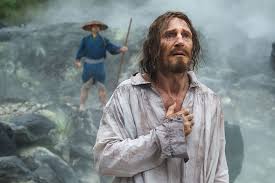
For a quarter of a century, Martin Scorsese has been working on a project about 2 Jesuit priests in 17th century Japan, which he says is his own passion of faith. But, after two and 3 quarter hours, even if you are sitting in one of those cushy multiplex recliners, you might just feel like you’ve been there for at least a few of those 25 years.
But hang on, Silence is not a bad movie – it’s a thoughtful film with a clear and profound narrative. Inspired by the 1966 novel with the same title, Japan in 1640 sees Christianity as a challenge to its core beliefs and leadership. Inquisitors are dispatched to cruelly force Christians and in particular the missionary priests who lead them, to renounce their faith. It’s a riveting story that raises serious questions about culture and beliefs – but admittedly it’s long and at times repetitive.
Missionary work in a closed society such as Japan in the day and age depicted must have been incredibly hard, frustrating and filled with danger. Even a casual observer of Silence who gets up for a popcorn refill would soon understand that without the lengthy narrative and the multiple examples of increasingly cruel torture.
Sadly, it’s not the only flaw in the movie – Andrew Garfield’s performance in the lead role as Father Sebastião Rodrigues falls short. Garfield cannot summon the gravitas that cast members Adam Driver and Liam Neeson bring to their roles as fellow Jesuits who embark on this life-threatening mission. Perhaps this is because visually there’s no escaping his schoolboy looks or maybe I was just waiting for Spider-Man to appear. Either way, it seems to be a simple case of mis-casting in what is otherwise a technically good performance.
All that said there’s plenty to like about the film. It’s shot in a breathtaking fashion with thoughtfully chosen locations in Taiwan and Taipei. The cinematography successfully recreates what one would imagine Nagasaki and its surrounding villages looked like in 1640. Rodrigo Prieto has worked with Scorsese before as well as other A list directors and it shows. There is a visual symmetry to the story that works very well and immediately transports you emotionally and viscerally to the time and place.
It’s also uniquely scored in a way that emulates the inherent natural beauty of the land while balancing it with the cruelty of the Nagasaki prisons where Garfield and his fellow Christians are held. In a head scratching twist, the husband and wife team of Kim and Kathryn Kluge, who wrote the music for the film, were disqualified from Oscar consideration because the score was not “musical” enough – which raises the question…. says who?
Liam Neeson, in a small but powerful role, plays Fr Cristóvão Ferreira the real life Jesuit missionary who renounces Christianity after years of being a role model of faith and courage to his fellow Jesuits. As others have previously noted, it’s refreshing to see Neeson in a role that allows him to exercise yet another set of “particular skills” beyond neck breaking action hero. His portrayal of the former Jesuit whose faith appears to be broken beyond repair is captivating and his stunning delivery of one of the story’s core concepts; the inexorability of belief, culture and environment is one of the high points of Silence. And while none of us have personal knowledge of 17th century Jesuits, Adam Driver’s portrayal of Fr Francisco Garrpe has a realism to it that seems to fit the story.
When all is said and done, Silence asks some serious questions albeit Scorsese may have been better served getting to them sooner. Some will walk away convinced that the central message is a cautionary tale about the lack of universality in religion and that missionary work, in some cases is futile. What is the value of attempting to impose a belief set on another in an inhospitable environment where it cannot flourish and grow? But that’s not the only message Scorsese is advancing and he makes that quite clear by using various methods – some overtly traditional and others somewhat subtler.
And for those that believe it, as it appears Scorsese does, the final message is both simple and profound – I carry your pain…always, I forgive you…always and in the silence of what may appear to be abandonment – I stand beside you…always.
 Writing Act Three